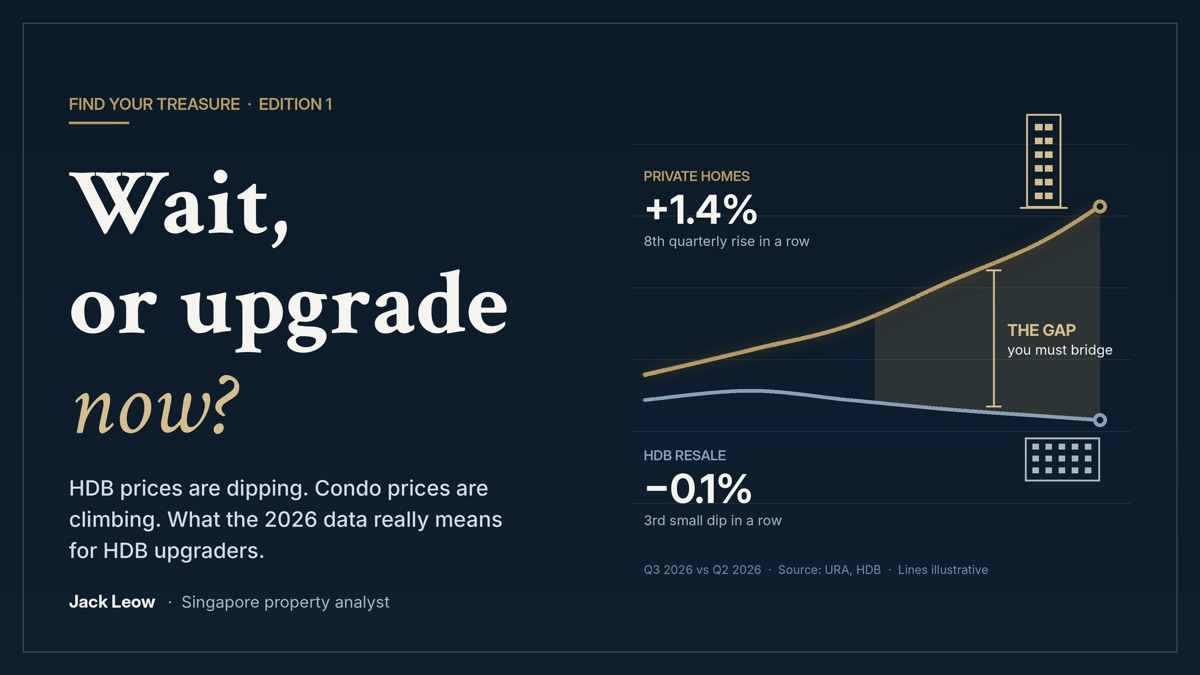
For most HDB upgraders, waiting for prices to crash is a bet, not a plan: in Q3 2026 private home prices rose 1.4% while HDB resale prices slipped 0.1%. If that pattern holds, every year you wait makes the jump from flat to condo bigger.
Upgrade when your need, your numbers and your buffer say so, not when the market does.
Q3 2026 was the eighth quarterly rise in a row for private homes, while HDB resale prices dipped for a third quarter. Waiting can still be the right call if you can't pass the bank's 4% stress test comfortably, don't have the cash to cover the gap between selling and buying, or your family doesn't need the space yet. The right time to upgrade is set by three things you control: your need, your numbers and your buffer.
Find Your Treasure · Edition 1. Figures correct as at 24 November 2026.
The rest of this guide shows you how to check all three, with real 2026 data and a worked example you can copy with your own figures.
Why this question keeps so many of us up at night
Let's be honest about what's really going on.
You've opened PropertyGuru at 11pm "just to look". You've done the mental maths in the shower. Your colleague just booked a unit at a new launch, and your parents keep asking when you're moving "somewhere bigger for the kids".
And somewhere in your head, two fears are fighting:
- The fear of overpaying. "What if I buy now and prices drop 10% next year? I'll be the fool who bought at the top."
- The fear of being left behind. "What if I wait and prices keep going up? Then I'll never be able to afford it."
Psychologists call this regret aversion. We don't only want a good outcome. We want to avoid the feeling of having made the wrong call. And because nobody can promise you which regret is coming, the easiest thing to do is nothing. We wait for a sign.
Here's the thing: the market will never send you a clear sign. When the news says "prices are falling", it feels too risky to buy. When the news says "prices are rising", it feels too late.
So instead of trying to time the market, this guide helps you answer a better question: "Is upgrading the right move for my family, at my numbers, this year?" That's a question you can actually answer.
What the 2026 numbers actually say
Before we talk about what you should do, let's look at what the market is doing. Every number below comes from an official release (URA or HDB) or a named research house. Sources are listed at the end.
Private homes: still climbing, but unevenly
| Measure | Change vs Q2 2026 | What it tells you |
|---|---|---|
| Overall private price index | +1.4% (Q2: +0.5%) | Fastest pace in almost two years |
| Landed homes | +2.9% | Landed led the gains |
| Non-landed, Outside Central Region (OCR, the suburbs) | +2.3% | Suburban condos did most of the work |
| Non-landed, Rest of Central Region (RCR, city fringe) | 0.0% | Flat |
| Non-landed, Core Central Region (CCR, prime) | +0.3% | Barely moved |
| Private rents | +1.3% | OCR rents up 3.1% |
| New homes sold (excl. ECs) | 1,183 units (Q2: 2,141) | Few launches, so fewer sales |
Source: URA, 3rd Quarter 2026 real estate statistics (23 October 2026).
Then October happened. Developers sold 1,716 new homes in October 2026, more than in the whole of Q3, mostly because of two big launches: Thomson Reserve and Lucerne Grand. Thomson Reserve alone sold 1,143 of its 1,268 units at its launch, at an average of about $2,900 psf.
What this means in plain English: buyers didn't disappear. They were waiting for something worth buying. When good projects launched, they moved fast.
HDB resale: a gentle cool-down, not a crash
| Measure | Figure | What it tells you |
|---|---|---|
| HDB Resale Price Index, Q3 2026 | 202.5, down 0.1% | Third small dip in a row |
| Resale flats sold, Q3 2026 | 7,645 (up 19.5% from Q2) | More flats changing hands, not fewer |
| Million-dollar flats, Q3 2026 | About 596 (a quarterly record) | Big, well-located flats still fetch top dollar |
| Full-year price growth, 2025 | 2.9% (down from 9.7% in 2024) | Growth slowed sharply before it flattened |
Sources: HDB 3rd Quarter 2026 public housing data; HDB Q4 2025 flash estimate; Huttons data reported by Stacked Homes.
Notice something odd? Prices dipped, but record numbers of million-dollar flats were sold in the same quarter. That's because the index is an average. Big, newer flats in mature estates are still in demand. Older, smaller flats in non-mature estates are feeling more competition.
The "gap" is what really matters to you
As an upgrader, you don't feel "the market". You feel the gap: the difference between what your flat sells for and what your next home costs.
When condo prices go up and HDB prices go sideways, the gap widens from both ends. Even small percentages add up fast, because a condo costs two to three times more than a typical flat. A 2% rise on a $1.6 million condo is $32,000. A 2% rise on a $650,000 flat is only $13,000.
Your flat would have to rise about 2.5 times faster than the condo (in percentage terms) just for the dollar gap to stay the same.
5 myths that are quietly costing upgraders money
Myth 1: "Prices will crash soon. I'll buy after."
The reality: A crash needs a trigger. Usually that means forced selling: lots of owners who can't pay their loans and must sell at any price. In Singapore, the rules make that much less likely. Banks must check that you can afford your loan as if interest rates were 4%, even when you're actually paying around 2%. Most buyers also put down at least 25%.
That doesn't mean prices can't fall. They can, and they have before. But "waiting for the crash" means betting your family's plans on an event nobody can schedule.
A fairer way to think about it: what would happen to your plan if prices simply stayed flat, or kept rising slowly for three more years? If that thought makes your stomach drop, waiting isn't as "safe" as it feels.
Myth 2: "HDB prices are falling, so I should hold my flat until they recover."
The reality: If you're upgrading, you're on both sides of the market. Yes, you might get a little less for your flat today. But if condo prices keep rising while you wait, you could lose more on the buying side than you gain on the selling side. What matters is the gap, not your flat's price on its own. We'll do the maths below.
Myth 3: "Interest rates are low now, so I can borrow more."
The reality: Not quite. Your actual rate affects your monthly instalment. But your maximum loan is worked out using MAS's 4% stress-test rate, under the Total Debt Servicing Ratio (TDSR). TDSR means all your monthly debt payments, including the new home loan, can't be more than 55% of your gross monthly income, calculated as if the loan rate were at least 4%.
So a cheaper loan makes life easier each month. It does not let you borrow more.
Also worth knowing: the benchmark rate behind most floating home loans (3-month compounded SORA) fell from about 3.2% in late 2024 to a low of about 1.03% in April 2026. It has since edged back up to around 1.38% in November 2026. Rates don't only go one way.
Myth 4: "Don't worry about the ABSD, I'll get it back."
The reality: You can get it back, but only if you meet all the conditions, and you have to pay it first.
If you're a married couple (at least one of you a Singapore Citizen) buying your second home jointly, you pay 20% Additional Buyer's Stamp Duty (ABSD) upfront. You can apply for a refund only if you sell your first home within 6 months of buying a completed property, or within 6 months of the new launch getting its TOP (Temporary Occupation Permit). On a $1.6 million condo, that's $320,000 you need to find within 14 days of signing, even if it comes back later.
Miss the 6-month window and the money stays with IRAS. This is the single most expensive mistake I see upgraders nearly make.
Myth 5: "So many flats are reaching MOP. HDB prices will fall a lot."
The reality: More supply is coming, and it will give buyers more choice. MND expects the number of flats reaching their Minimum Occupation Period (MOP) to rise from about 13,500 in 2026 to 15,000 in 2027 and 19,500 in 2028.
But here's what people forget: many of those owners are upgraders too. They will sell flats and buy condos. More MOP flats can mean softer HDB prices and stronger condo demand at the same time. That's not good news for someone waiting to upgrade. Research house Realion actually expects HDB resale prices to rise 2% to 4% in 2027, with cash-rich buyers supporting prices even as supply rises. Forecasts are just forecasts, but they show that "more supply = big fall" is far from certain.
The real cost of waiting: a worked example
Let's make this real. Meet a typical upgrader couple. (The numbers are illustrative, not anyone's real case. Swap in your own.)
Wei Ming and Hui Ling, both 38, Singapore Citizens, one child, another on the way.
- Their 4-room HDB flat could sell for about $650,000
- Outstanding HDB loan: $150,000
- CPF used for the flat, plus accrued interest, to be refunded to their CPF accounts: $250,000
- Combined gross income: $14,000 a month, no other loans
- Target: a 3-bedroom suburban (OCR) condo at about $1,600,000
Today, their gap is $1,600,000 − $650,000 = $950,000. Now, what happens to that gap if they wait two years? I ran four scenarios.
| Scenario (2 years) | Condo price | HDB price | New gap | Change vs today |
|---|---|---|---|---|
| A. Condos +3%/yr, HDB flat | $1,697,440 | $650,000 | $1,047,440 | +$97,440 |
| B. Both rise +1%/yr | $1,632,160 | $663,065 | $969,095 | +$19,095 |
| C. Condos +2%/yr, HDB +3%/yr | $1,664,640 | $689,585 | $975,055 | +$25,055 |
| D. Condos −5%, HDB −2% (total) | $1,520,000 | $637,000 | $883,000 | −$67,000 |
Illustrative only. Not a forecast. Calculations by the author.
Look carefully at scenario C. Even when the HDB flat grows faster than the condo in percentage terms, the dollar gap still widens. That's the maths of starting from a smaller number.
Only in scenario D, where condo prices actually fall, does waiting save money. And even then, ask yourself: would you really feel brave enough to buy in a falling market? Most people don't. They wait some more.
This doesn't mean "buy now". It means waiting has a cost too, and you should count it honestly instead of treating it as free.
Can you actually afford it? The 4% test
Wanting to upgrade and being able to upgrade comfortably are two different things. Here's how the bank will look at Wei Ming and Hui Ling.
Step 1: The loan
With no other outstanding home loan, the maximum bank loan is generally 75% of the price (if the tenure is 30 years or less and doesn't run past age 65). At least 5% of the price must be paid in cash.
| Item | Amount |
|---|---|
| Purchase price | $1,600,000 |
| Bank loan (75%) | $1,200,000 |
| Minimum cash down payment (5%) | $80,000 |
| Cash or CPF (another 20%) | $320,000 |
| Buyer's Stamp Duty (BSD) | $49,600 |
| ABSD if they buy before selling (20%, refundable if conditions are met) | $320,000 |
Step 2: The stress test
| Loan tenure | Monthly instalment at 4% (bank's test) | % of $14,000 income | Max loan their income supports at 4% |
|---|---|---|---|
| 25 years | $6,334 | 45.2% | About $1,458,800 |
| 30 years | $5,729 | 40.9% | About $1,612,900 |
They pass the 55% TDSR limit either way. To borrow $1.2 million over 25 years, a household would need a gross income of roughly $11,500 a month with no other debts. Over 30 years, roughly $10,400. Try your own figures in the mortgage calculator.
Step 3: What they'd actually pay each month
| Interest rate | 25-year loan | 30-year loan |
|---|---|---|
| 2.2% | $5,204 | $4,556 |
| 2.6% | $5,444 | $4,804 |
| 3.5% (if rates rise) | $6,007 | $5,389 |
Calculations by the author. Your bank's figures will differ slightly.
Here's my honest take as someone who used to audit numbers for a living: passing the bank's test is the minimum, not the target. I'd want a family to feel fine paying the 3.5% line, not just the 2.2% line. A 0.5% rise in rates adds about $300 a month on this $1.2 million, 25-year loan. That's a few family dinners. A 1.3% rise is closer to $800 a month. That starts to hurt.
Rule of thumb
If your loan instalment at 3.5% would eat more than about 40% of your take-home pay, slow down. Build more buffer first.
Sell first or buy first? Pick your risk
This is where most of the stress lives. Each route has a different risk. Neither is "right". Pick the one you can live with.
| Sell your HDB first | Buy your condo first | |
|---|---|---|
| ABSD | None to pay (you own no other home when you buy) | Pay 20% upfront, claim a refund only if you sell within 6 months |
| Money needed upfront | Lower | Much higher (5% cash + BSD + ABSD = about $449,600 on a $1.6M condo) |
| Main risk | Nowhere to stay for a while; you may feel rushed into buying | Your flat sells slower or cheaper than planned |
| Bank loan limit | Clean: you'll have no outstanding home loan | Check with your bank: some may apply a lower limit (45%) while your HDB loan is still outstanding |
| Best for | Families with somewhere to stay (parents, short rental) and a clear target | Families with strong cash or CPF, and a flat in an area that sells easily |
A middle path many upgraders use: buy a new launch under construction. If the flat is sold within 6 months of the new project's TOP, the couple can claim the ABSD refund. That gives a few years to plan the flat sale, but the 20% ABSD still has to be paid upfront, and the progressive payments start while you're still paying your HDB loan. Run the cash flow month by month before you sign.
Who should move now, and who should wait?
There's no single answer for everyone. Here's how I'd think about it for different situations.
The growing family (like Wei Ming and Hui Ling)
The need: space, a good school nearby, a home that fits the next 10 years.
Lean towards moving if you pass the 4% test with room to spare, have 6 to 12 months of expenses saved after the down payment, and your timeline is fixed (a baby coming, Primary 1 registration in two years). Your need has a deadline. The market doesn't.
The "we're comfortable, but…" upgrader
The need: usually status, lifestyle, or a feeling that "we should be in a condo by now".
Lean towards waiting if the move is mostly about keeping up with friends. An HDB flat in a good location isn't a failure. A stretched condo loan with no buffer can be a real one. Be honest with yourselves about why you want to move.
The flat owner worried about the lease
The need: protecting the value of your home over the long term.
If your flat is older, the question isn't just "condo or not". It's "how long do I plan to stay, and who will buy my flat when the lease is shorter?" This deserves its own deep dive. Don't make the decision on fear alone.
The investor buying a second property
The need: income and growth.
Different rules apply. As a Singapore Citizen buying a second home, you pay 20% ABSD with no refund, and if you sell within 4 years you may also pay Seller's Stamp Duty of up to 16% (for homes bought on or after 4 July 2025). Your test is net rental yield after costs, not "will prices go up". Private rents did rise 1.3% in Q3 2026, but the private vacancy rate also rose to 7.2%.
Empty nesters thinking of right-sizing
The need: unlocking cash, an easier home to manage.
Good news for some: since 28 July 2026, private property owners can buy a non-subsidised HDB resale flat without the old 15-month wait, as long as they don't take an HDB loan. Moving the other way (condo to resale flat) is now much simpler.
Save this: the upgrade readiness checklist
Before you book a viewing, tick these off honestly.
Need
- ☐ We can name the real reason we want to move (space, school, family, lease), not just "everyone else is"
- ☐ We plan to stay at least 5 years (transaction costs and the 4-year SSD period make short stays expensive)
Numbers
- ☐ We know our flat's likely selling price from recent HDB transactions, not from the highest listing
- ☐ We've checked our CPF refund, including accrued interest, on the CPF website
- ☐ We've worked out our cash proceeds: sale price − outstanding loan − CPF refund − costs
- ☐ We pass the 4% stress test, and the instalment at 3.5% still feels okay
- ☐ We've got an In-Principle Approval (IPA) from a bank in writing
Buffer
- ☐ After the down payment, we still have 6 to 12 months of household expenses
- ☐ If we buy first: we have the ABSD cash ready and a realistic plan to sell within 6 months
- ☐ If we sell first: we have a place to stay and a shortlist ready
If you can't tick most of these yet, that's not failure. That's your to-do list.
7 common mistakes I see upgraders make
- Pricing their flat off the highest listing. Listings are wishes. Transactions are facts. Use HDB's resale data for your block and nearby blocks.
- Forgetting the CPF refund. When you sell, the CPF you used, plus accrued interest, goes back to your CPF account first. Many sellers are shocked how little cash is left.
- Treating ABSD as "only temporary". Temporary money still has to be real money in your account within 14 days.
- Stretching to the maximum loan. The bank tells you what you can borrow, not what you should.
- Ignoring the timeline. HDB resale, condo completion and your loan approvals all have their own clocks. Write them on one page.
- Buying the "project of the month" without comparing. A hot launch isn't automatically good value. Compare its psf with nearby resale condos of a similar age and size.
- Waiting for perfect certainty. It doesn't exist. Good decisions are made with clear numbers and a buffer, not perfect timing.
What to watch over the next 12 months
If you're not ready to move yet, use the time well. Track these signals:
- New supply. The Government Land Sales Confirmed List for 2026 offers 9,320 private homes, more than 50% above the 10-year average. URA counts about 32,800 private homes that could become available for sale in the next one to two years. More supply usually means more choice and less pressure on prices.
- Interest rates. 3-month SORA has crept up from its April 2026 low. Watch your instalment, not the headlines.
- MOP wave. More flats reaching MOP in 2027 and 2028 means more competition when you sell. If your flat is in a block with many MOP units, selling earlier may face less competition than selling later.
- Your own life. Promotion, new baby, parents' health, school plans. These matter more than any index.
Want a second pair of eyes on your numbers?
Your flat's realistic value, your CPF refund, sell-first versus buy-first timing. A free 30-minute session with the maths shown either way, even if the answer is "wait".
Book a Free ConsultationFrequently asked questions
Are Singapore property prices going to drop in 2027?
Nobody can say for sure. In Q3 2026, private home prices rose 1.4% while HDB resale prices dipped 0.1%. More supply is coming from Government Land Sales and flats reaching MOP, which could slow price growth. But strong demand at big launches like Thomson Reserve shows buyers are still active. Plan around your own numbers, not a forecast.
Is it a good time for HDB upgraders to buy a condo in 2026?
It's a good time for some. If you pass the bank's 4% stress test comfortably, have 6 to 12 months of savings left after the down payment, and have a real need, waiting may cost you more than it saves, because the gap between HDB and condo prices has been widening. If you can't meet those conditions yet, waiting and building a buffer is the wiser move.
Do I need to pay ABSD when upgrading from an HDB flat to a condo?
Only if you buy the condo before you sell your flat. Singapore Citizens pay 20% ABSD on a second home. A married couple (at least one a Singapore Citizen) buying jointly can claim a refund if they sell their flat within 6 months of buying a completed condo, or within 6 months of a new launch's TOP. You must pay the ABSD first.
How much income do I need to buy a $1.6 million condo?
Roughly $11,500 a month (gross household income, no other debts) for a 75% loan of $1.2 million over 25 years, or about $10,400 over 30 years. That's because banks must test your loan at a 4% interest rate under the 55% TDSR limit. This is a minimum. A safer target is an income where the instalment at 3.5% still feels comfortable.
Should I sell my HDB first or buy my condo first?
Selling first avoids ABSD and keeps your cash needs low, but you may need temporary housing. Buying first lets you secure the home you want, but you need to pay 20% ABSD upfront and sell within 6 months to get it back. Choose based on your cash and your tolerance for each risk.
Why are HDB resale prices falling while condo prices are rising?
HDB resale prices have dipped slightly for three quarters in a row as more flats reach their MOP and come onto the market. Private prices rose, led by landed homes and suburban condos, supported by strong demand at new launches. The two markets serve different buyers, so they don't always move together.
Can I borrow more because interest rates are low?
No. Your maximum loan is set using a 4% stress-test rate, not your actual rate. Low rates reduce your monthly instalment, but they don't raise your loan limit.
Can private property owners buy an HDB resale flat now?
Yes. Since 28 July 2026, private property owners can buy a non-subsidised HDB resale flat without serving the previous 15-month wait-out period, as long as they don't take an HDB housing loan. A 30-month wait still applies for subsidised flats, such as BTO flats or resale flats bought with housing grants.
The bottom line
The market will keep moving. Headlines will keep swinging between "boom" and "cooling". Your neighbour will keep having an opinion.
But the families who upgrade well have one thing in common. They didn't guess the market right. They knew their numbers, kept a buffer, and moved when their life needed them to.
If you take one thing from this edition, let it be this: spend one evening this week filling in the checklist above with your real figures. Just one evening. You'll know more about your next move than months of scrolling listings ever told you.
Find Your Treasure is Jack's weekly newsletter: one Singapore property question answered with real data and plain English. New editions appear here in Insights every Tuesday.
Sources & References
- URA, Release of 3rd Quarter 2026 real estate statistics (23 October 2026). ura.gov.sg
- HDB, 3rd Quarter 2026 public housing data and Resale Price Index (via HDB and The Money Bees summary of HDB data, 23 October 2026).
- HDB, Flash Estimate of 4th Quarter 2025 Resale Price Index. hdb.gov.sg
- HDB, Removal of the 15-month wait-out period (27 July 2026). hdb.gov.sg
- IRAS, Additional Buyer's Stamp Duty rates and Remission of ABSD for a Married Couple. iras.gov.sg
- MAS / MOF / MND, Extension of the SSD holding period (3 July 2025). mas.gov.sg
- MAS, Loan tenure and loan-to-value limits. mas.gov.sg
- MAS, Macroprudential policies in Singapore (TDSR, MSR, 4% medium-term rate). mas.gov.sg
- MND, Speech by Minister Desmond Lee at the Committee of Supply Debate (MOP numbers).
- 99.co, October 2026 developer sales (URA data). 99.co
- 99.co, Thomson Reserve launch sales. 99.co
- Stacked Homes, HDB resale prices fell last quarter (Huttons million-dollar flat data).
- EdgeProp, Realion 2027 HDB outlook (27 October 2026).
- SORA data: MAS compounded SORA as reported by Propwise (20 November 2026) and PropertyNet (November 2026).